Knowledge Discovery with Infrathon
Claude’s Quant-VideoGen codec improves compression and video quality over the human codec.
Codec comparison
We compare the codec developed by Claude Opus 5.5 during a 24-hour run with the human Quant-VideoGen codec. The evaluation uses HY-WorldPlay on WorldScore and LongCat-Video on MovieGen, with 200 samples per dataset.
Evaluation setup
Both codecs and the uncompressed BF16 reference use the same inputs and generation settings.
PSNR, SSIM, and LPIPS compare the first segment generated with compressed KV against the BF16 reference.
Human versus Claude
Entries report Human → Claude. Higher compression, PSNR, and SSIM are better; lower LPIPS is better.
| Video model | Dataset | Compression ↑ | PSNR (dB) ↑ | SSIM ↑ | LPIPS ↓ |
|---|---|---|---|---|---|
| HY-WorldPlay | WorldScore | 6.75× → 20.89× | 31.15 → 36.33 | 0.923 → 0.975 | 0.059 → 0.023 |
| LongCat-Video | MovieGen | 6.88× → 18.83× | 23.67 → 26.95 | 0.836 → 0.884 | 0.126 → 0.085 |
Mean compression across the two evaluations increases from 6.82× to 19.86×. Both datasets also show improvements in PSNR, SSIM, and LPIPS.
What the agent discovers
The human codec quantizes the residuals left after clustering the cache one value at a time. Claude instead transforms those residuals using principal component analysis and applies entropy coding after quantization.
Claude’s codec improves compression and video quality. Mean PSNR increases by approximately 5.2 dB on WorldScore and 3.3 dB on MovieGen.
An example of optimization with Infrathon
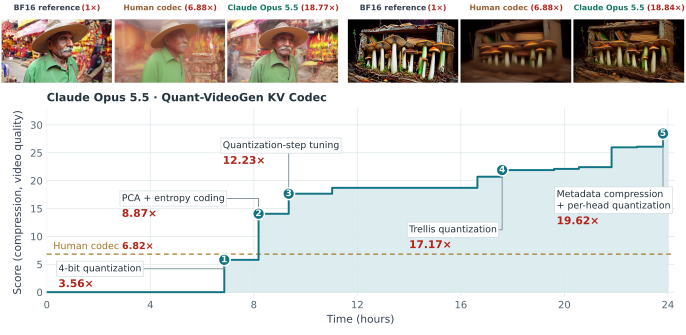
Improvements across submissions
Iterative optimization of the KV codec
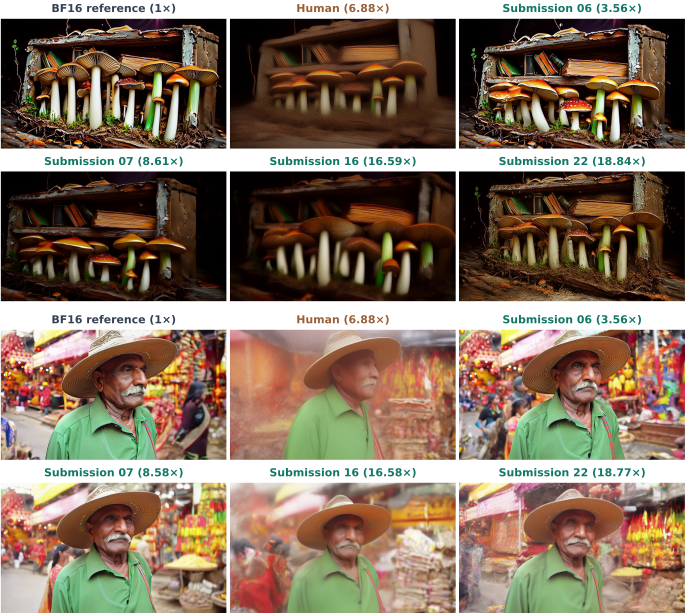
From submission 16 to 22, compression rises from approximately 16.6× to 18.8× on both displayed samples while mushroom textures and facial details become clearer.
Building new discovery tasks
Infrathon-build helps researchers turn their own infrastructure problems into tasks. Infrathon then supplies an execution and feedback loop for comparing agent solutions with existing implementations and iterating from test feedback.